Introduction
For California educators, the Mid-Year LCAP Update is more than a compliance task. This update is a checkpoint for student progress, program performance, and strategic investments. As ESSER funds sunset and accountability measures evolve, schools are expected to back every goal and dollar with actionable data.
Yet, many teams still juggle disconnected spreadsheets and siloed systems, struggling to see the full story. A data-driven approach changes that, transforming a static report into a roadmap for continuous improvement.
1. Turning Data into a Living LCAP
The Local Control and Accountability Plan (LCAP) should evolve as student needs shift. However, static tools often limit that flexibility. The Mid-Year LCAP Presentation Template from Parsec Education provides a simple framework to turn data into a dynamic conversation starter rather than a compliance report.
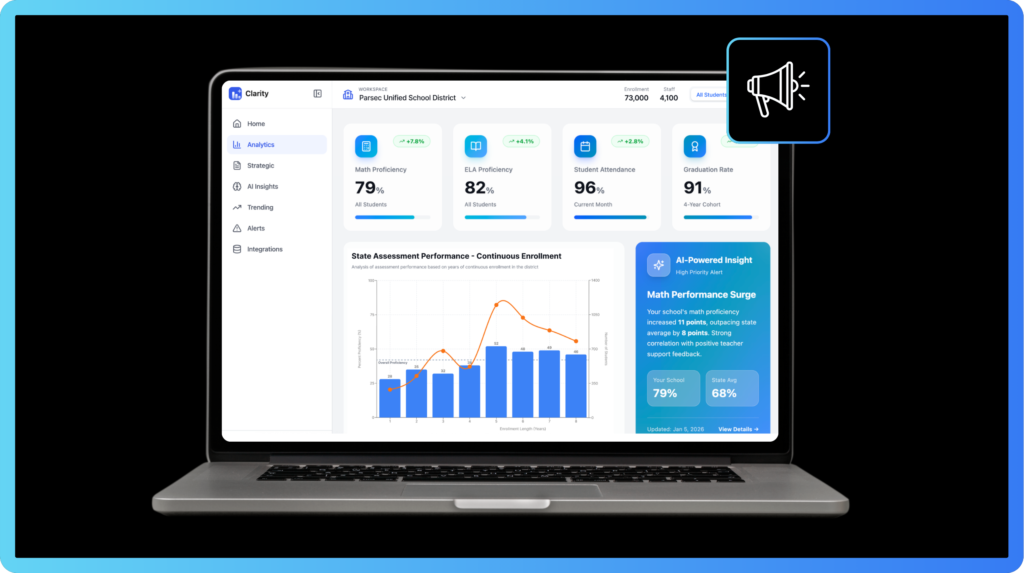
By using Parsec’s Clarity Platform, schools can centralize metrics such as academic achievement, attendance, and discipline, automatically aligning them to LCAP goals. This creates a single source of truth that supports real-time reflection and action.
As WestEd’s blog on evidence-based practices notes, schools that embed continuous reflection into their improvement cycles see stronger outcomes. Likewise, California Engage’s overview of the LCAP process highlights that flexibility and adaptation are key to authentic progress.
When educators can access live data, LCAP conversations shift from compliance to collaboration, and from anecdotes to measurable evidence.
2. Using LCAP Clarity to Drive Continuous Improvement
True continuous improvement requires ongoing insight, not just annual reporting. When schools connect their dashboards to state priorities such as engagement, achievement, and school climate; they gain an immediate pulse on what’s working.
With Parsec’s Insights Tool, administrators and coaches can monitor trends across sites and student groups in real time. This level of clarity allows them to intervene early, ensuring end-of-year outcomes are shaped, not surprised.
The WestEd article on assessment and accountability trends emphasizes that data use must be proactive, not reactive. Similarly, the Institute of Education Sciences’ toolkit on continuous improvement guides educators to collect, analyze, and act on data iteratively throughout the year.
Beyond metrics, schools need to evaluate the quality of their actions. The Mid-Year LCAP Template integrates Implementation and Effectiveness rubrics that help teams assess not just whether actions happened, but how well they were carried out and whether they’re changing outcomes. When paired with Parsec’s Real tool, these reflections transform qualitative insights into actionable data for continuous improvement.
When teams engage in ongoing inquiry cycles, mid-year reflection becomes an engine for sustained improvement, not just a compliance exercise.
3. Elevating Stakeholder Engagement with Transparent Data
Stakeholder engagement has always been central to the LCAP process, but its impact depends on how accessible the data is. Parsec Education Resources like our presentation templates, encourages schools to use clear visuals and concise summaries that help communities understand progress at a glance.
Creating a shared view of impact with classroom data that connects directly to school goals, giving teachers, parents, and board members is imperative to telling your schools story. This approach aligns with WestEd’s blog on leading school improvement plans, which stresses that accessible data drives better decision-making.
Qualitative data reveals the why behind the numbers. Using Parsec Real, educators can capture student and parent voices to contextualize trends. For instance, low participation in a Parent Advisory Committee may point not to disinterest, but to scheduling barriers—insights that allow leaders to redesign engagement strategies with empathy and precision.
Moreover, the California School Boards Association’s guidance on data transparency shows that clear, visualized data builds trust and strengthens community engagement. When stakeholders can interpret and interact with performance information, they become collaborators in student success.
Visual summaries – like the LCAP metric tables showing baseline, current, and target data – help boards and communities instantly grasp progress. Clear visuals turn complex accountability data into accessible stories of improvement.
4. Strengthening Accountability and Compliance
Compliance shouldn’t consume weeks of administrative time.
With Parsec’s Real Tool, teams can gather qualitative insights. From student voice to teacher reflection, to explain the “why” behind the numbers. As the Public Policy Institute of California’s article on school accountability underscores, effective accountability systems depend on accessible, transparent data.
5. Using Data to Inform Future LCAP Goals
Mid-year reflection is most powerful when it shapes future planning. Through Parsec Insights, schools can compare multi-year trends to identify where progress is accelerating or stalling. These insights inform goal-setting for the next LCAP cycle.
As the California Budget & Policy Center’s piece on funding explains, data-driven budgeting ensures resources flow to the students who need them most. Likewise, the Education Commission of the States’ blog on data-informed decision-making emphasizes that local agencies using performance clarity see stronger, more targeted results.
When data informs direction, reflection turns into foresight and the LCAP becomes a living strategy, not a backward-looking report.
6. Connecting Mid-Year Data to Year-End Impact
Mid-year data doesn’t just describe outcomes; it predicts them. When schools use clarity to monitor performance in real time, they can adjust before goals slip out of reach.
For example, if math proficiency falls behind mid-year, Parsec Clarity can reveal whether attendance dips or curriculum pacing are contributing factors. Leadership can then reallocate tutoring resources or adjust supports before June.
Schools that link reflection slides like “What’s Next” directly to their upcoming actions build a living LCAP that evolves and isn’t just referenced once.
This approach reflects WestEd’s “Continuous Improvement in Action” article, which advocates using data to know where to allocate resources, and the American Institutes for Research’s overview of early warning systems, which demonstrates how predictive analytics can change the trajectory of struggling students.
By connecting reflection to real-time intervention, schools transform the LCAP from a reporting task into a system of adaptive leadership.
7. Building Capacity for Data-Driven Leadership
Technology can organize data, but people give it meaning. Sustainable, data-driven LCAP success depends on educators who can interpret and act on information confidently.
Parsec’s Real and Insights platforms make exploration intuitive, and when paired with data literacy training, they help staff connect daily decisions to long-term goals. The WestEd resource on educator data use highlights how data fluency drives collaboration across departments. Similarly, the New Leaders blog on building capacity for data literacy emphasizes that empowered staff are the backbone of continuous improvement.
When schools invest in people as much as platforms, they build a culture where every decision is informed by evidence and every educator feels ownership of outcomes.
8. The Future of LCAP and Data Clarity
The future of LCAP is digital and adaptive. With advances in artificial intelligence, schools can soon use predictive models and real-time dashboards to detect emerging gaps and recommend interventions before performance declines.
Forward-thinking leaders are already exploring AI-driven tools for resource allocation and subgroup monitoring. Parsec’s evolving Clarity and Insights platforms integrate these innovations, helping schools bridge planning with measurable performance.
EdTech Evidence Exchange article on AI and equity highlights the potential for technology to enhance as a way of not replacing but adding in human judgment.
By embracing these tools, schools can make their mid-year LCAP not just compliant, but transformative.
Conclusion: Making Mid-Year LCAP Count
The mid-year LCAP review isn’t a mere update, it’s an opportunity to turn data into direction. When schools embrace clarity and qualitative insight together, they gain the clarity and agility to adapt strategies and improve student outcomes in real time.
Data doesn’t replace the human side of education! Data gives leaders the evidence they need to make every student count, every strategy measurable, and every decision intentional.
Download Parsec Education’s Mid-Year LCAP Presentation Template for your school to create a smarter, faster, and more impactful mid-year process.